For New Olim
✅ Israeli law checked August 2026
🏆 PwC-Reviewed Compliance
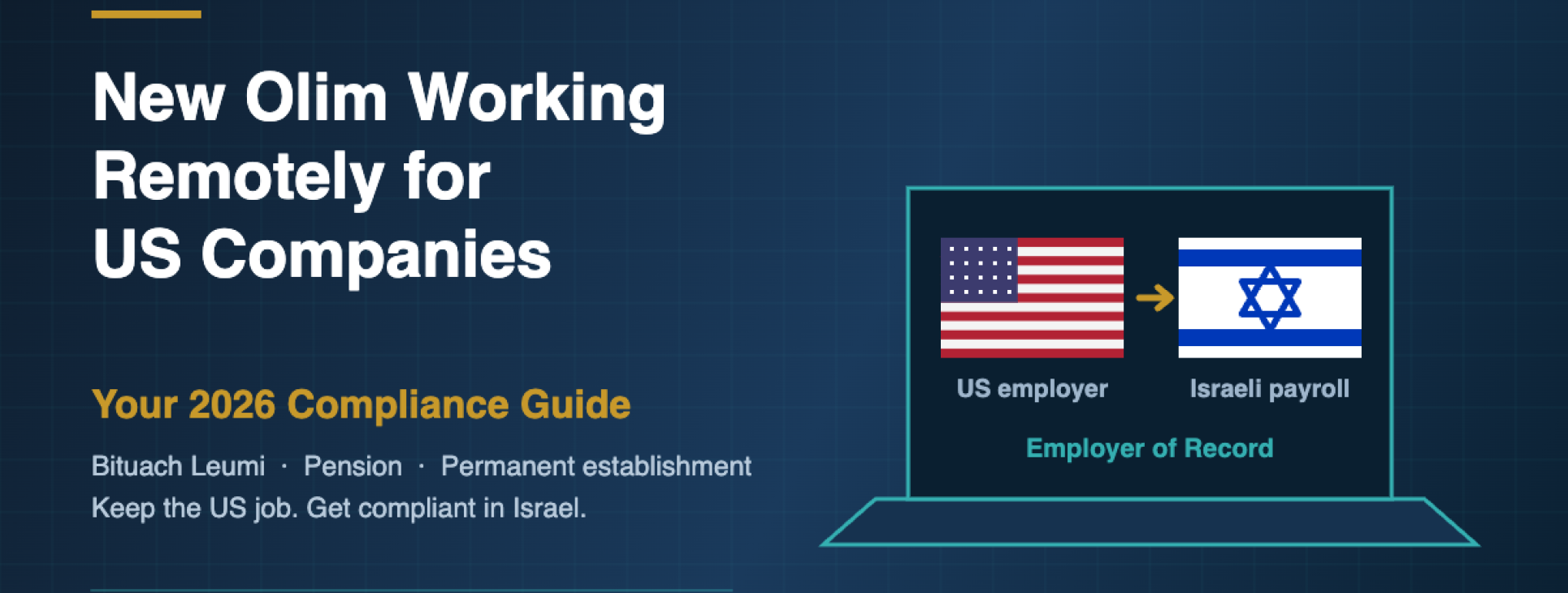
New Olim Working Remotely for US Companies: Your 2026 Compliance Guide
New Olim working remotely for US companies do not have to give up the job in order to make aliyah. A remote employment compliance structure is the set of Israeli and US legal steps that let a new Oleh keep working for a US employer from Israel without breaking tax, payroll, or immigration rules on either side. Thousands of Olim try to freelance-it through this transition and discover, months later, that their US employer has unknowingly created payroll tax and permanent establishment exposure in Israel. CWS Israel has spent 12 years building the compliant path between the two systems. This guide walks through exactly what a new Oleh working remotely for a US company must do in 2026, and where it can go wrong.
Can a new Oleh keep working remotely for a US company after aliyah?
Yes. A new Oleh can keep their US job after aliyah, but only if the employment relationship is restructured to be legal in Israel. As of 2026, simply continuing to receive a US paycheck while physically living in Israel, with no Israeli payroll registration, is a compliance gap for both the employee and the employer.
The core problem is that Israeli labour law applies based on where the work is physically performed, not where the company is incorporated. The moment an Oleh’s feet are on the ground in Israel and they are doing paid work, Israel considers them subject to Israeli employment, tax, and National Insurance (Bituach Leumi) rules, regardless of who signs their paycheck. Employers who assume “they’re just working from home for us” is a US-only matter are the ones most likely to discover a compliance gap during an Israeli tax audit or a Bituach Leumi eligibility dispute.
What happens if a US employer keeps paying an Oleh on US payroll?
Keeping an Oleh on pure US payroll while they live and work in Israel exposes both sides to real, quantifiable risk. As of 2026, the two biggest exposures are Israeli permanent establishment (PE) risk for the employer and missed Israeli social benefits for the employee.
📄 Permanent establishment risk: If a US company has an employee habitually working from Israel, Israeli tax authorities can treat that as the company having a taxable presence in Israel. If PE is established, the US company becomes liable for Israeli corporate tax at 23% (2026 rate) on the portion of profit attributable to that presence, plus 18% VAT exposure and full Israeli payroll tax obligations, assessed retroactively from when the arrangement began.
💰 No Bituach Leumi coverage: An Oleh paid only on US payroll is not making Israeli National Insurance contributions, so they are not building entitlement to Israeli maternity benefits, unemployment insurance, disability coverage, or the National Insurance component of severance.
🛡️ No Israeli pension accrual: Under Israel’s general expansion order for mandatory pension insurance, the employer contributes 6.5% of salary to the pension component and a further 6% to the severance component once the employee becomes eligible, alongside a 6% employee contribution. An Oleh kept off Israeli payroll accrues none of this, and loses months or years of pension building during exactly the period aliyah absorption support (Sal Klita) is meant to cushion.
💼 US withholding mismatch: US employers are generally not equipped to withhold correctly, or at all, for an employee who has become an Israeli tax resident, which can create a US year-end reconciliation mess for the Oleh.
How an Employer of Record works for new Olim working remotely for US companies
An Employer of Record (EOR) is a third-party organisation that becomes the Oleh’s legal employer in Israel, handling Israeli payroll, Bituach Leumi, pension, and tax withholding, while the Oleh continues doing the exact same day-to-day work for the same US company. CWS Israel’s Olim First Steps programme is built specifically for this handoff, and full EOR pricing details are published here.
- Step 1. Quote and terms: CWS Israel issues a quote outlining the conditions of employment and links to the governing terms and conditions. The Oleh reviews and accepts the quote, and there is no separate “employment contract” to sign, since CWS Israel is the registered legal employer, not the US company.
- Step 2. Payroll and National Insurance registration: CWS Israel registers the Oleh for Israeli payroll, Bituach Leumi, and health tax, typically within 48 hours of the quote being accepted.
- Step 3. Ongoing compliant employment: The Oleh keeps working for the US company day-to-day. CWS Israel runs monthly Israeli payroll (Form 102 filings), Bituach Leumi contributions (in 2026 the employer pays 4.51% on the portion of salary up to ₪7,703 a month and 7.6% above that, up to the maximum insurable income of ₪51,910, while the employee pays 4.27% and 12.17% across the same two bands including health tax), and statutory pension contributions once eligible.
- Step 4. PwC-reviewed compliance: CWS Israel’s payroll and employment practices undergo an annual PwC compliance review, giving both the Oleh and the US company documentary assurance the arrangement is being run correctly.
New Olim using CWS Israel’s Olim First Steps programme also receive a 25% discount on EOR fees for their first year, recognising that the early absorption period is already financially stretched.
What Israeli statutory benefits does an EOR unlock for a new Oleh?
Moving onto compliant Israeli EOR employment gives a new Oleh access to the full set of Israeli statutory employment protections, on top of whatever benefits their US company already offers informally.
| Benefit | Staying on US payroll only | Employed via CWS Israel EOR |
|---|---|---|
| Bituach Leumi (National Insurance) | Not contributing, no coverage | Registered from day one. Employer pays 4.51% up to ₪7,703 a month, then 7.6% (2026) |
| Pension contributions | None accrued in Israel | 6.5% employer pension plus a 6% severance component, once eligible (2026) |
| Annual leave | Whatever the US company informally offers | 16 days a year in years 1 to 5 under the Annual Leave Law, which is 12 actual working days on a five-day week, rising with seniority |
| Sick leave | Not legally accrued in Israel | 1.5 days per month statutory accrual (2026) |
| Dmei Havraah (recovery pay) | Not applicable | ₪451.50 per day in 2026. Five days after one year of service, so ₪2,257.50, rising with seniority |
| Severance protection | None under Israeli law | One month’s salary per year of service under the Severance Pay Law, about 8.33% of salary, with at least 6% deposited monthly under the pension order |
What about US taxes and reporting while employed via an Israeli EOR?
Moving onto Israeli EOR payroll does not remove US tax obligations. US citizens remain taxable on worldwide income regardless of where they live or who employs them. New Olim working remotely still need to plan for both sides of the border.
As of 2026, the FBAR (FinCEN Form 114) threshold remains $10,000 in aggregate across all foreign financial accounts at any point in the year, and an Israeli bank or pension account can trigger this quickly. FATCA’s Form 8938 has a higher threshold: for a single filer living abroad it starts at $200,000 of specified foreign financial assets at the end of the year, or $300,000 at any point during the year, with different figures for other filing statuses. The 10-year Oleh tax exemption shields new immigrants from Israeli tax on foreign-sourced income and capital gains, but two points are easy to get wrong. Salary for work physically performed in Israel is Israeli-source income, so the 10-year exemption does not shelter it, which is exactly why the Israeli payroll question cannot be deferred. And following an April 2024 amendment to the Income Tax Ordinance, olim and veteran returning residents who become Israeli tax residents on or after 1 January 2026 no longer hold the old reporting exemption: the tax exemption itself survives, but foreign income and foreign assets must now be reported to the Israel Tax Authority even where no Israeli tax is due. The exemption also does not touch US filing obligations, which continue regardless of Israeli residency status. Olim who keep a US-sourced salary while living in Israel should expect to coordinate a US tax preparer familiar with the Foreign Tax Credit alongside their Israeli payroll provider.
How does CWS Israel differ from a global EOR platform for this situation?
Global EOR platforms can technically register an Israeli employee, but new Olim have a status, and a set of benefits, that a generic global platform is not built to navigate. CWS Israel is a local Israeli specialist that has built its Olim First Steps programme specifically around the Oleh Chadash transition.
🛡️ CWS Israel is an SIA (Staffing Industry Analysts) member and undergoes an annual PwC compliance review, giving US employers a documented compliance trail rather than a black-box global platform. CWS Israel also provides English-first contracts and reporting, plus multilingual support in English, Hebrew, Russian, and Arabic, which is useful for Olim navigating Israeli bureaucracy for the first time while still working full-time hours for a US employer. For the equivalent US-company-side view of this problem, see our guide on US companies hiring Israeli talent compliantly, and for the broader legal backdrop see remote work legal requirements in Israel.
What are the first 90 days meant to look like?
The first 90 days after aliyah are the highest-risk window for this exact compliance gap, because Olim are focused on absorption logistics and assume the employment question can wait. It should not wait.
- Before landing or in week one: Tell the US employer aliyah is happening and that Israeli employment law will apply once work resumes from Israel. Most US HR teams have never handled this and will default to “just keep doing what you’re doing” unless prompted.
- Weeks 1–2: Get a CWS Israel quote for Olim First Steps EOR employment, review the conditions, and accept it. This does not require waiting for Teudat Oleh paperwork to fully clear.
- Weeks 2–3: CWS Israel registers Israeli payroll, Bituach Leumi, and health tax, typically live within 48 hours of quote acceptance.
- By day 90: Full compliant Israeli employment is running in parallel with the same US company relationship, the absorption basket continues on the basis of Oleh status, and the Oleh has statutory Israeli protections in place.
Frequently Asked Questions
Can I keep my US job after making aliyah?
Yes. Most new Olim can keep their US job after aliyah by moving onto a compliant Israeli employment structure, such as an Employer of Record, rather than staying on unregistered US-only payroll. CWS Israel’s Olim First Steps programme is built for exactly this transition.
Does working remotely from Israel for a US company create tax problems for the employer?
It can. As of 2026, a US company with an employee habitually working from Israel risks being deemed to have a permanent establishment there, exposing it to Israeli corporate tax at 23% and payroll tax obligations. An Employer of Record structure removes this risk because the EOR, not the US company, is the registered Israeli employer.
Will using an EOR affect my Sal Klita absorption basket payments?
The absorption basket is paid by the Ministry of Aliyah and Integration on the basis of your status as an Oleh, not as a means-tested unemployment benefit, so moving from US payroll to compliant Israeli EOR payroll does not in itself change that entitlement. Some supplementary forms of assistance carry their own conditions, so confirm your own case with the Ministry of Aliyah and Integration.
Do I still have to file US taxes if I’m employed through an Israeli EOR?
Yes. US citizens are taxed on worldwide income regardless of who employs them or where they live, so annual US filing continues. The 2026 FBAR threshold of $10,000 in aggregate foreign accounts and FATCA Form 8938 reporting still apply alongside your Israeli employment.
How fast can CWS Israel get my Israeli payroll set up?
CWS Israel typically completes Israeli payroll, Bituach Leumi, and health tax registration within 48 hours of you accepting the employment quote, with zero onboarding fees and a 25% discount on EOR fees for Olim in their first year.
What is the difference between an EOR and just staying an independent contractor to my US company?
An independent contractor arrangement shifts compliance risk onto you personally and gives you none of the statutory Israeli employee protections such as Bituach Leumi, pension, or severance. An EOR makes you a properly registered Israeli employee while you continue the same day-to-day work for your US company.
Sources and further reading
- National Insurance Institute of Israel, contribution rates for salaried employees
- Israel Tax Authority, history of VAT rates
- Internal Revenue Service, comparison of Form 8938 and FBAR requirements
This guide is general information for new Olim working remotely for US companies. It is not legal or tax advice. Statutory figures were checked against primary sources in August 2026 and are subject to change.
Keep Your US Job. Get Compliant in Israel.
CWS Israel’s Olim First Steps programme gets new Olim onto compliant Israeli payroll in 48 hours, so you can keep working for your US employer without risking either side’s compliance.
✓ Onboard in 48 hours
✓ Multilingual support
✓ PwC annual compliance review
✓ 25% first-year Olim discount
